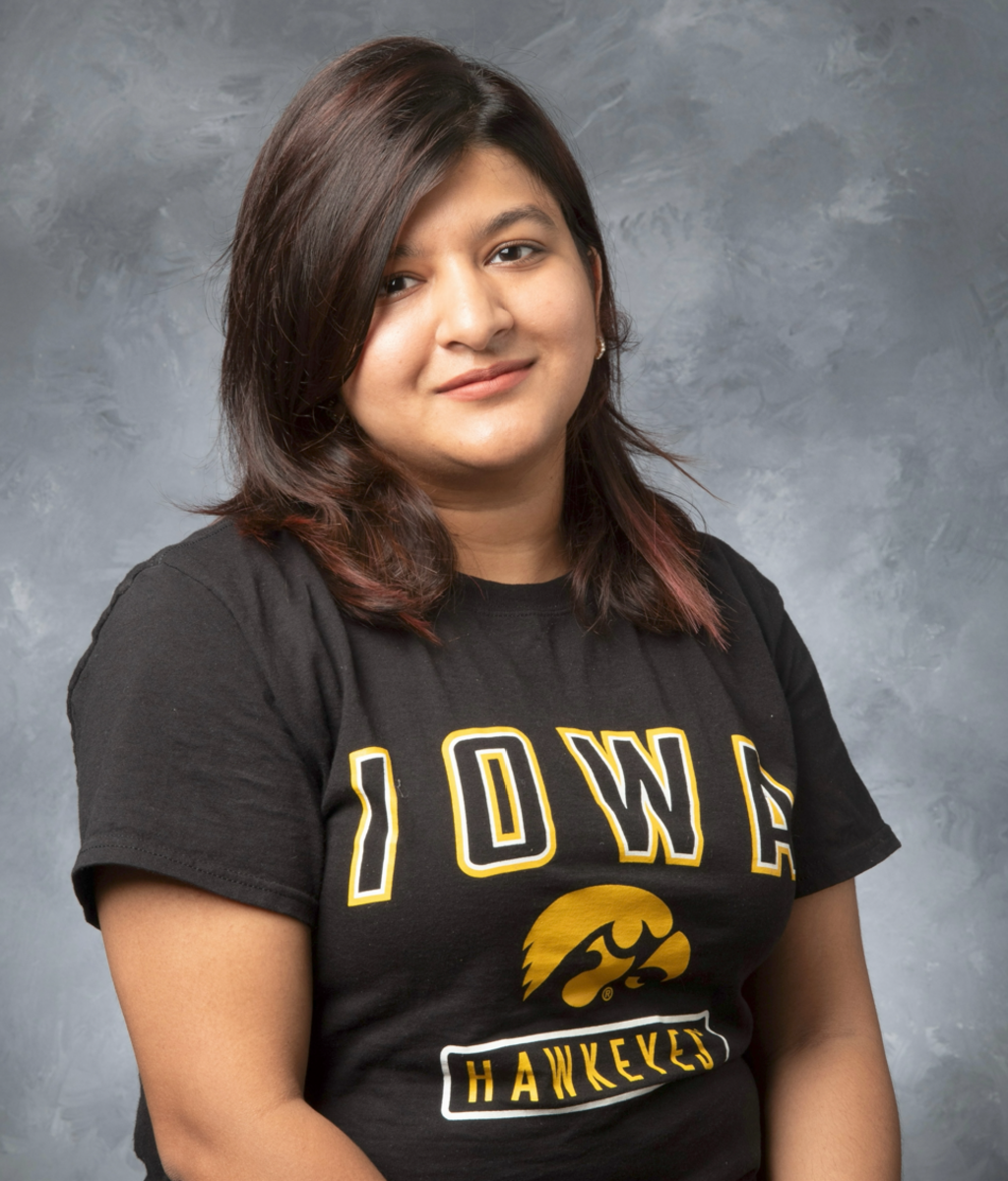
When some people hear the word “math,” it sparks memories of high school classrooms with old calculators and anxiety-inducing algebra and calculus courses. For Nuzhat Nuari Khan Rivu, math means something much more exciting.
As a second-year PhD student in the Applied Mathematical and Computational Sciences (AMCS) Program, Rivu doesn’t study math in the way that most people think. She is not drawing long theoretical equations down a chalkboard. Instead, she is applying math to the real world.
“I use mathematical models to simulate how a disease might spread in a population. It is like creating a digital twin of an epidemic, which helps us test different strategies before they are applied to the real world,.”
Mathematical models require many different components, including understanding who is susceptible to disease, who is infectious, who knows they are infectious, and education about prevention and treatment.
Rivu describes her work as the bridge between math and biology. Her research examines how diseases spread and how interventions, like vaccination or treatment programs, can help control epidemics.
“These questions affect real people, so it’s very rewarding to work on them,” she says.
Early Equations
Diseases and epidemics have been part of Rivu’s entire college and graduate studies. The Covid-19 pandemic was not just something she lived through; she also studied the data in real time.
As an undergraduate at the University of Dhaka in Bangladesh, Rivu studied how Covid-19 was spreading in Bangladesh, specifically how the infection rate was changing as vaccines became more widely available. This research was her own idea.
“So many people around me were getting doses of the vaccine. So, I wanted to know how the vaccines were helping the infection rate,” she said.
Using mathematical models to analyze available data, Rivu calculated the effects of each of the three vaccine doses as they were introduced. If more time had been available, she wanted to explore which dose, and which vaccines were most effective.
During her master’s program, Rivu’s research was focused on a different disease – HIV. However, instead of looking at just Bangladesh, Rivu used data and ideas from UNAIDS and their 95-95-95 program, which is focused on HIV testing, education, and viral suppression to prevent spread.
HIV treatments and education require significant resources. While there is no cure for HIV, it can be effectively managed with lifelong antiretroviral therapy (ART). Using data from UNAIDS, Rivu calculated which policies and programs were the most cost-effective, and the impact that interventions would have on disease spread. This type of data analysis helps policymakers understand the best options and visualize the results of investments.

Variables of Belonging
Moving to Iowa for her doctoral program was the first time that Rivu had been away from her family. Iowa was a change of pace from the bustling city of Dhaka.
The calm and quiet pace in Iowa is something she quickly learned to love. For her, it is a perfect environment for graduate students, and she highly recommends it.
While she does have some extended family in the United States, they live mostly on the West Coast. Rivu managed to find her own community at the university. Outside of her small cohort, Rivu has connected with other Bangladeshi students and is an involved member of the International Student Advisory Board (ISAB), which she joined in her first year on campus.
“I love ISAB because we have the authority to raise and talk about issues and try to do something about them. Not everyone gets that opportunity,” she describes.
She has also found friends in the Iowa City community. Maria and Kevin, a married couple that Rivu met through InterVarsity Graduate Christian Fellowship, even brought her meals while she was studying for her qualifying exam, a favor she will always remember.
Differential Paths
Rivu’s undergraduate and master’s degrees are both in mathematics, which she refers to as “pure math.” For her PhD, she searched for applied math programs that would allow her to use math instead of theory. She was interested in seeing the real-world impact.
“I love applied math because it is tangible. You can actually see its impact. It not only helps poeple directly but also plays a bigger role in shaping policies. Unlike pure math, which is more abstract, applied math feels real and meaningful,” she said.
The interdisciplinary component of Iowa’s program made it attractive. AMCS allows students to apply math to a variety of disciplines, including health care, business, and engineering. For Rivu, the integration with the clinical side and the hospital was another pull.
“I started working on epidemiology during my undergrad and master’s, focusing on how infections spread. Now in my PhD, I may expand into physiology, which is more about how diseases affect the body itself.”
In her doctoral studies, Rivu has moved away from studying epidemics at the population level to focusing on the individual level. She now uses different equations to model processes within the body, exploring how blood flow and concentration of elements like chlorine and sodium influence the effectiveness of medicine.
For Rivu, math is more than numbers and theoretical equations. It is a way to model the world and connect disciplines. Her work proves that sometimes the most powerful solutions begin with a simple equation.